
DIY waste
Next year, anyone wishing to dispose of excess amounts of DIY waste at the Household Recycling Centres (HRCs) will incur a small charge.
A charge will only apply if the DIY waste you bring in is above the free allowance for your household.
Any income generated by the new system will be reinvested into local services, help meet the council’s budget commitments, and protect the continued provision of the HRC service.
It also supports fairness. Residents carrying out larger DIY projects will contribute towards the additional cost of dealing with that waste, while everyday household waste and recycling, as well as DIY waste within the allowance, remains free to dispose of.
What is the free allowance?
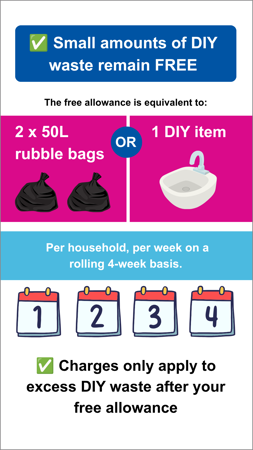
The free allowance is the equivalent of 2 x 50-litre rubble bags or one large item (such as a bath or a kitchen sink) per household, per week on a rolling 4-week basis.
What is classed as DIY waste?
Do-It-Yourself (DIY) waste is rubbish created from home improvements, renovations, or demolition projects undertaken by residents, including fixtures, fittings, rubble, soil, and building waste.
What is not DIY waste?
Everything else you may want to bring to your local HRC is not classed as DIY waste (for example washing machines, batteries, cardboard, glass, garden waste, clothing and general waste).
Commercial waste isn’t accepted at our HRCs and needs to be disposed of using skips or commercial waste services – it’s not classed as DIY waste.
Will the disposal of everything else at the Household Recycling Centre still be free?
Yes. Everyday household waste and recycling will remain free, and residents can continue to visit the centres as often as needed.
When will the charges for excess DIY waste begin?
The charges are expected to be introduced in early 2027. We will provide more details of exact dates when these have been confirmed.
Below are some examples of the planned charges:
Rubble and soil
A 50-litre bag of brick, rubble, rock, soil or turf will cost £5.00 per bag.
Breeze blocks (maximum of 5*) will cost £1.00 each.
Small paving slabs (maximum of 5*) will cost £1.00 each.
Large paving slabs (maximum of 2*) will cost £2.50 each.
*Quantities shown will act as a single item for the purposes of the free allowance limit.
Small paving slab (under 600mm x 600mm); large paving slab (600mm x 600mm or larger).
Fixtures and fittings
Most single items will cost £2.50 each.
Some examples of single items include: bath, basin, basin pedestal, door, shower tray, toilet cistern, toilet pan, kitchen worktop, garage door, fence panel and bathroom cabinet.
Some items, such as guttering and skirting board, will be charged on length (for example, a 3-metre length of guttering or a 2-metre length of skirting board will cost £2.50 each).
Plasterboard
A 50-litre bag or a sheet of plasterboard (up to 2.4m x 1.2m) will cost £10.00.
Below are some examples of the planned charges:
Rubble and soil
A 50-litre bag of brick, rubble, rock, soil or turf will cost £5.00 per bag.
Breeze blocks (maximum of 5*) will cost £1.00 each.
Small paving slabs (maximum of 5*) will cost £1.00 each.
Large paving slabs (maximum of 2*) will cost £2.50 each.
*Quantities shown will act as a single item for the purposes of the free allowance limit.
Small paving slab (under 600mm x 600mm); large paving slab (600mm x 600mm or larger).
Fixtures and fittings
Most single items will cost £2.50 each.
Some examples of single items include: bath, basin, basin pedestal, door, shower tray, toilet cistern, toilet pan, kitchen worktop, garage door, fence panel and bathroom cabinet.
Some items, such as guttering and skirting board, will be charged on length (for example, a 3-metre length of guttering or a 2-metre length of skirting board will cost £2.50 each).
Plasterboard
A 50-litre bag or a sheet of plasterboard (up to 2.4m x 1.2m) will cost £10.00.
Excess DIY waste will be assessed when you first arrive at the HRC. Site staff will look at the type and amount of DIY waste you have brought and compare it with the free allowance.
If the DIY waste is within the allowance, no charge will apply. If it is above the allowance, staff will confirm what is chargeable using the published charging table.
Excess DIY waste will be assessed when you first arrive at the HRC. Site staff will look at the type and amount of DIY waste you have brought and compare it with the free allowance.
If the DIY waste is within the allowance, no charge will apply. If it is above the allowance, staff will confirm what is chargeable using the published charging table.
When you book an HRC slot, you will be asked what type of waste you want to dispose of.
Site staff are also experienced in checking waste types as part of normal site operations and will be able to identify common DIY waste such as rubble, soil, tiles, bathroom fittings, doors, fencing, plasterboard and similar DIY waste materials.
If staff identify DIY waste that has not been declared, they will assess it against the free allowance before it is deposited. If it is within the allowance, no charge will apply.
If it is above the allowance, you will be asked to pay for the excess DIY waste or take the excess waste away again.
When you book an HRC slot, you will be asked what type of waste you want to dispose of.
Site staff are also experienced in checking waste types as part of normal site operations and will be able to identify common DIY waste such as rubble, soil, tiles, bathroom fittings, doors, fencing, plasterboard and similar DIY waste materials.
If staff identify DIY waste that has not been declared, they will assess it against the free allowance before it is deposited. If it is within the allowance, no charge will apply.
If it is above the allowance, you will be asked to pay for the excess DIY waste or take the excess waste away again.
It can be costly to handle and dispose of DIY waste.
The free allowance means residents can still dispose of substantial amounts without charge, while those producing larger amounts of DIY waste make a contribution towards the additional disposal costs, rather than those costs falling wholly on council taxpayers.
It can be costly to handle and dispose of DIY waste.
The free allowance means residents can still dispose of substantial amounts without charge, while those producing larger amounts of DIY waste make a contribution towards the additional disposal costs, rather than those costs falling wholly on council taxpayers.
This approach keeps normal household waste and recycling free for everyone, while asking those producing larger volumes of DIY waste to contribute towards the additional cost of handling and disposal.
This approach keeps normal household waste and recycling free for everyone, while asking those producing larger volumes of DIY waste to contribute towards the additional cost of handling and disposal.
Council tax helps fund core household waste and recycling services.
Excess DIY waste from larger home improvement projects is different from normal household and recycling services and creates additional costs.
The free allowance means substantial amounts can still be disposed of without charge, while larger amounts are charged in a way that is more proportionate.
Council tax helps fund core household waste and recycling services.
Excess DIY waste from larger home improvement projects is different from normal household and recycling services and creates additional costs.
The free allowance means substantial amounts can still be disposed of without charge, while larger amounts are charged in a way that is more proportionate.
The free allowance is designed to make sure substantial amounts of DIY waste can still be disposed of without charge.
Everyday household waste and recycling will remain free of charge, and charges only apply where DIY waste goes above the allowance. The council will monitor the impact of the changes as part of the planned review (for more information see question: 'Will the changes to the HRCs, including the charges, be reviewed?' below).
The free allowance is designed to make sure substantial amounts of DIY waste can still be disposed of without charge.
Everyday household waste and recycling will remain free of charge, and charges only apply where DIY waste goes above the allowance. The council will monitor the impact of the changes as part of the planned review (for more information see question: 'Will the changes to the HRCs, including the charges, be reviewed?' below).
The council wants residents to continue using HRCs and recycling as much of their waste as possible.
Household recycling and most household waste will continue to be free. The free DIY allowance is intended to keep lawful disposal accessible while applying charges to excess DIY waste only.
The council wants residents to continue using HRCs and recycling as much of their waste as possible.
Household recycling and most household waste will continue to be free. The free DIY allowance is intended to keep lawful disposal accessible while applying charges to excess DIY waste only.
Clear information will be published before the charges are introduced, including examples of what is free and what is chargeable.
If residents bring more than the free allowance and do not want to pay, they can take the excess DIY waste away and still dispose of their other household waste and recycling as normal.
Clear information will be published before the charges are introduced, including examples of what is free and what is chargeable.
If residents bring more than the free allowance and do not want to pay, they can take the excess DIY waste away and still dispose of their other household waste and recycling as normal.
Yes, of course. You can book a time slot to visit the HRC in the normal way. If the DIY waste you bring is within the free allowance, there will be no charge. If it goes above the free allowance, you can pay to dispose of the excess DIY waste either in advance or when you arrive on site. The rest of your household waste and recycling can still be disposed of for free.
Yes, of course. You can book a time slot to visit the HRC in the normal way. If the DIY waste you bring is within the free allowance, there will be no charge. If it goes above the free allowance, you can pay to dispose of the excess DIY waste either in advance or when you arrive on site. The rest of your household waste and recycling can still be disposed of for free.
Residents should separate DIY waste from other household waste and recycling where possible. This will help site staff identify what falls within the DIY waste allowance and make sure any charge only applies to the relevant excess DIY waste.
Residents should separate DIY waste from other household waste and recycling where possible. This will help site staff identify what falls within the DIY waste allowance and make sure any charge only applies to the relevant excess DIY waste.
Yes. Around one third of councils currently charge for excess DIY waste. Examples include Berkshire, Leicestershire, Oxfordshire, Somerset and Warwickshire.
Yes. Around one third of councils currently charge for excess DIY waste. Examples include Berkshire, Leicestershire, Oxfordshire, Somerset and Warwickshire.
Yes. All visits to an HRC, whether bringing DIY waste or not, must be prebooked.
Yes. All visits to an HRC, whether bringing DIY waste or not, must be prebooked.
The council is planning to accept payments online when booking or on site. Payments will be by card only.
Residents who need help or have specific access needs can contact the council for advice before visiting.
The council is planning to accept payments online when booking or on site. Payments will be by card only.
Residents who need help or have specific access needs can contact the council for advice before visiting.
Any service changes are closely monitored and kept under review. A full review will be undertaken of the excess DIY charges after the system has been in place for six months, and then again after a year.
The findings will be used to inform any changes needed to the way the system operates.
Any service changes are closely monitored and kept under review. A full review will be undertaken of the excess DIY charges after the system has been in place for six months, and then again after a year.
The findings will be used to inform any changes needed to the way the system operates.
You can choose not to dispose of the excess DIY waste on that visit and take it away with you. You can still dispose of any other household waste and recycling as normal.
You can choose not to dispose of the excess DIY waste on that visit and take it away with you. You can still dispose of any other household waste and recycling as normal.
No, we are not changing the number of visits that can be booked. Residents can continue to visit as often as required to bring in their waste and recycling.
No, we are not changing the number of visits that can be booked. Residents can continue to visit as often as required to bring in their waste and recycling.
Waste produced from a tradesperson doing work for you in your home is classed as commercial waste and isn’t accepted at our HRCs. The person undertaking the work should take the waste away to dispose of it using a commercial waste site or by using a skip. This type of waste is not household DIY waste.
If you pay someone to take waste away, you should check that they are a licensed waste carrier and keep a record of who took the waste. This helps reduce the risk of waste being fly-tipped and protects residents from potential responsibility if their waste is disposed of illegally.
Waste produced from a tradesperson doing work for you in your home is classed as commercial waste and isn’t accepted at our HRCs. The person undertaking the work should take the waste away to dispose of it using a commercial waste site or by using a skip. This type of waste is not household DIY waste.
If you pay someone to take waste away, you should check that they are a licensed waste carrier and keep a record of who took the waste. This helps reduce the risk of waste being fly-tipped and protects residents from potential responsibility if their waste is disposed of illegally.
Please email waste@gloucestershire.gov.uk
Please email waste@gloucestershire.gov.uk
Last reviewed: